
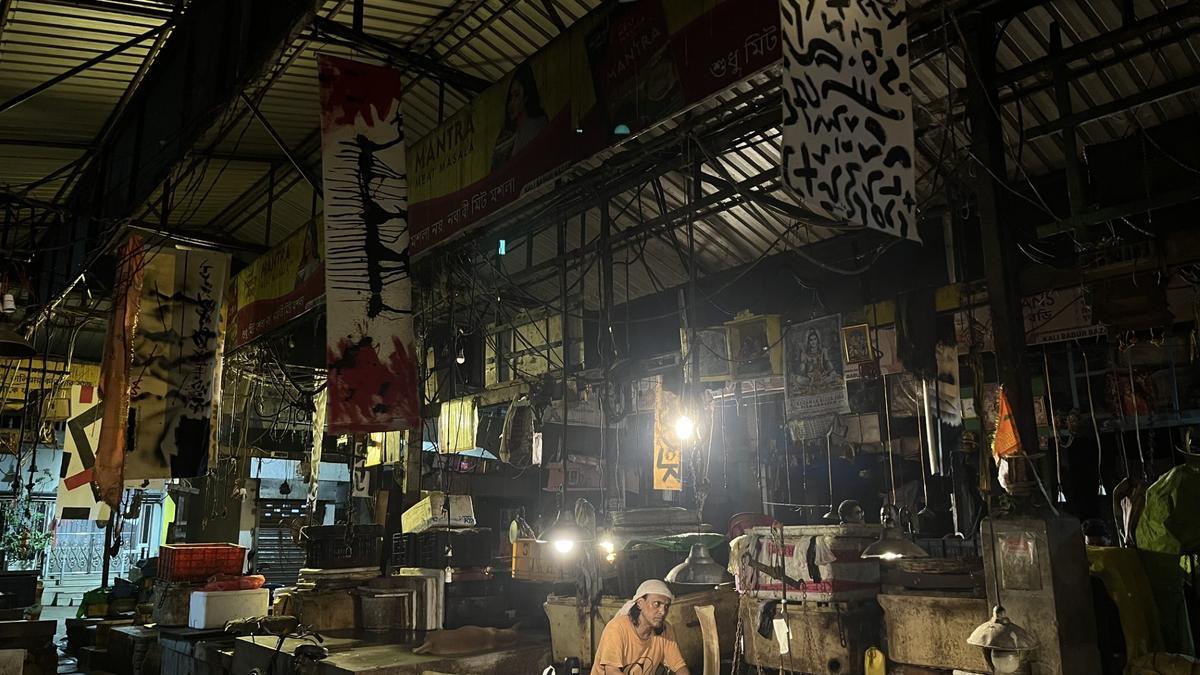
Hundreds of buyers who went to buy fish at the nearly 300-year-old fish market at Kalibabur Bazar in West Bengal’s Howrah were in for an unexpected treat as they witnessed a live showcase of paintings by Kolkata-based postmodernist artist Hiran Mitra. The event, which also featured live performances in the evening, spanned from July 9 to July 11, transforming the bustling fish market into an open-air gallery.
As many as 31 new paintings by Mr. Mitra were displayed at various spots within the fish market for three days, from Tuesday to Thursday, forming a part of the ‘Art in Every One’ public art initiative helmed by Kolkata-based multidisciplinary arts group Howrah Jonaki. This initiative marked its second edition at the Kalibabur Bazar following a successful debut on December 31, 2023, and January 1.
Born in 1945, Mr. Mitra is an alumnus of Kolkata’s Government College of Arts and Crafts, and he has managed to carve a unique niche for himself by blending elements of performance art with his paintings. His avant-garde exhibition this week illustrated his continued commitment to making art accessible to the masses outside conventional gallery spaces.
“This idea was born when Mr. Mitra expressed his wish to showcase his paintings outside of gallery spaces, bringing his art directly to the people in more local and engaging settings,” said Biswajit Das, the creative director of Howrah Jonaki. Das revealed that on an average day, the entire bazaar sees a footfall of nearly 15,000 people. “Many assumed there was a film shooting going on when they saw the artworks adorning the fish market. Reactions ranged from curiosity and amazement to indifference and misunderstanding,” he explained.
For Mr. Das, the crux of the initiative lay in diverting people’s attention away from their phone screens and towards a more mindful engagement with their physical surroundings. “The fish vendors were particularly thrilled, and many felt honored to be part of a multidisciplinary art project,” he added. Highlighting the impact of the event, Das recounted how Bulu, a fish vendor, was inspired to take up painting as a hobby after interacting with Mr.
. Mitra’s artworks.
Amidst the morning rush, the fish market also featured performances of theatre, dance, music, and performance poetry in the evenings. On July 10, Howrah Jonaki presented their interpretation of the Athenian tragedy Antigone right in the heart of the bustling fish market, captivating fish buyers, sellers, and art enthusiasts alike.
Sukumar Mondol, 52, who has sold fish in Kalibabur Bazar for nearly 30 years, expressed his deep admiration for Mr. Mitra’s initiative. “As a fish seller, it is an honor to have Mr. Mitra’s paintings displayed here. Many of my buyers were shocked and confused by the artworks, unable to fathom their presence in a fish market,” Mondol observed. “The general perception is that a fish market is a dirty place, but I believe that artists find inspiration anywhere, even amidst what others see as dirt,” he stated.
Arabinda Bandopadhyay, a ninth-generation descendant of Kali Banerjee who established the extensive marketplace in Howrah, confirmed the fish market’s significant status in the state. “Our family has always had a profound connection with the arts, and we are delighted to support such community-centered initiatives,” he told The Hindu. “Art displayed in such crowded public spaces ensures that a wider audience can experience it, enriching the community’s cultural life,” he remarked.
The live art exhibition at Kalibabur Bazar is not only a testament to Hiran Mitra’s vision but also an example of how art can transcend traditional spaces to touch the lives of ordinary people. It highlighted the coexistence of commerce and culture, underscoring the belief that beauty and creativity can thrive in any environment, even within the busy, pungent spaces of a fish market. The vibrant atmosphere created by this fusion of art and daily life served as a reminder that inspiration can be found everywhere, and that art truly belongs to everyone.
As the fish market returns to its usual rhythms, the lingering impact of this unique cultural event will undoubtedly continue to inspire and provoke thought among its visitors and sellers alike, demonstrating the transformative power of art in everyday life.