
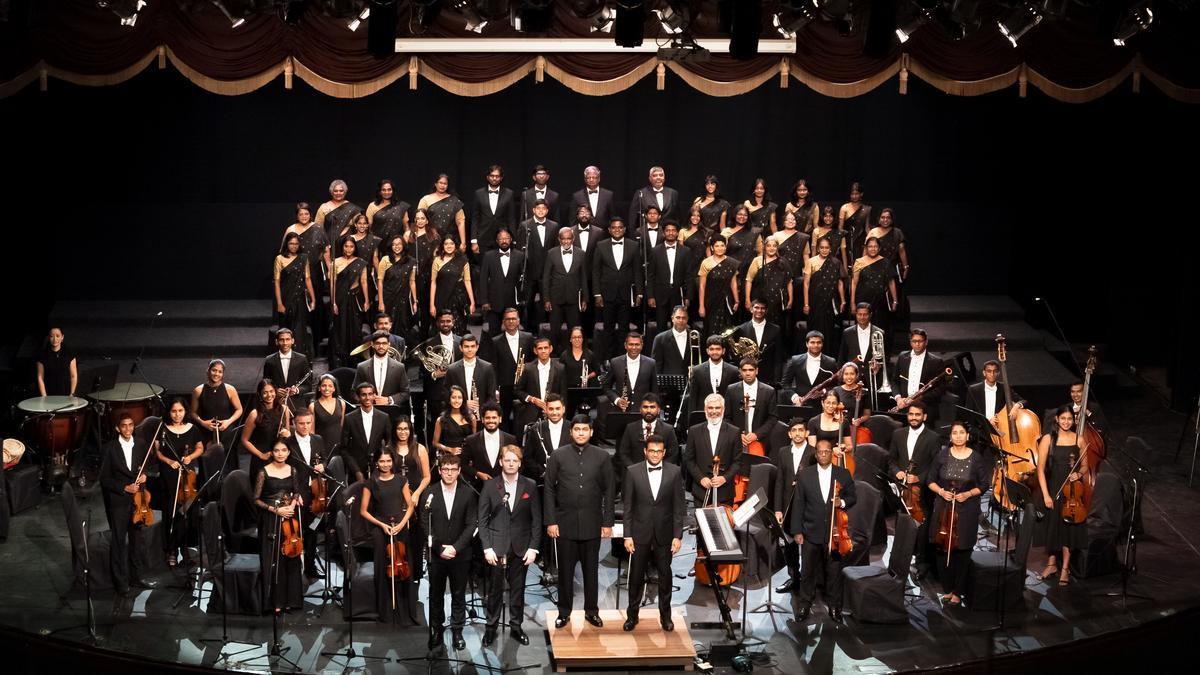
The Sir Mutha Venkatasubba Rao Concert Hall in Chennai played host to a monumental evening as the Madras Guild of Performing Arts (MGPA) and the Gustav Mahler Society of Colombo (GMSC) introduced the Indian audience to F.J. Haydn’s magnum opus, ‘The Creation’. This collaboration marked a significant milestone as it was the GMSC’s first international tour, drawing anticipation and excitement from a diverse audience keen to experience the sonorous magic of Haydn’s genius.
The concert hall became an auditory sanctuary as the evening unfolded, filled with the paired murmurs of experienced classical music enthusiasts and those newly curious about the genre. The event set the stage for a mesmerizing journey through Haydn’s interpretation of creation, pivoting on inspirations drawn from the Biblical Book of Genesis and John Milton’s epic, ‘Paradise Lost’.
The concert’s heartbeat was Atul Jacob Isaac, the talented conductor spearheading the MGPA. Infused with both vision and fervor, Isaac was tasked with bringing Haydn’s intricate compositions to life. Reflecting on his journey, Isaac mentioned the honor of applying his skills honed through his Viennese training to this performance. “Conducting Haydn’s work with both the choir and orchestra was an affair of deep passion and precision,” Isaac noted, highlighting the grounded musical expertise both groups brought to the table.
The performance commenced with “The Representation of Chaos,” a masterstroke capturing the embryonic vibrations of the universe. Each note was deftly rendered by the orchestra, painting a cosmic tapestry with string murmurs, brass rumbling, and woodwind flutters, all contributing to the grand dialogue of creation. A pinnacle of the night was the transition from C Minor to C Major upon utterance of the word “light”, a moment Isaac described as one of sheer luminosity. “We orchestrated the lighting to accompany the music, enhancing the divinity of the moment when the choir decreed ‘And there was light’,” explained Isaac, as the stage flooded with brilliance.
.
The evening featured stellar vocal performances: soprano Kristina Ammattil gracefully portrayed Gabriel and Eve, while tenor Ramon Branch Biescas’ portrayal of Uriel resounded with clarity and emotive depth. Baritone Maximilian Catalano added richness to the characters of Raphael and Adam, each performance intertwining into a narrative both dramatic and beautiful.
In a poignant cultural homage, the encore included “Danno Budunge,” a famed Sri Lankan composition celebrating Anuradhapura’s splendor. Composed by Pt Visvanath Lauji, an Indian with a passion for Western classical music, the orchestral arrangement by Manilal Weerakoon served as a magnificent fusion of Sri Lankan, Indian, and Western influences. This grand finale was a vivid reminder of the shared musical heritage and bonds between nations.
Conductor Srimal Weerasinghe of the GMSC emphasized the cultural significance of the collaboration, which transcended a mere showcase of musical skill. “It was a celebration of human connection, a testament to music’s ability to cross borders and speak across languages,” Weerasinghe remarked.
The event prompted reflections on the future of Western classical music in Chennai. Discussions centered on how the city might cultivate a deeper appreciation for this genre while honoring its own rich musical traditions. Renowned pianist Anil Srinivasan called for democratizing the musical experience. “Fostering community engagement through demos and workshops, and encouraging student participation in performances can foster dialogue and understanding,” Srinivasan suggested.
As Atul Jacob Isaac looked back on the performance, he hoped that Haydn’s final masterpiece would continue to resonate, leaving an indelible imprint on all who heard it. “Whether you’re a seasoned listener or a newcomer, this oratorio is bound to find its way into your heart,” he expressed, underscoring the timeless allure of Haydn’s creation.