
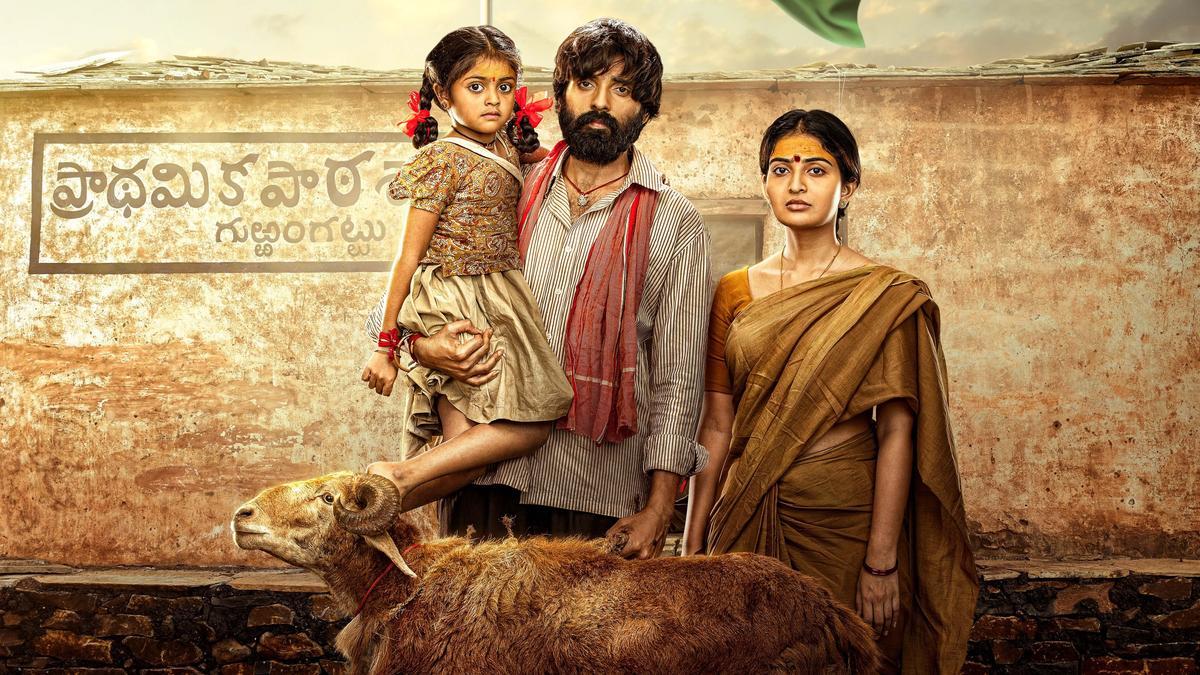
The newly released Telugu film “Pottel,” crafted by writer-director Sahit Mothkuri, explores gritty realities and the transformative power of education in overcoming oppression. Set in the Vikarabad region of Telangana a few decades ago, the film’s narrative, though historical in its setting, presents a message that resonates strongly with contemporary audiences. Mothkuri’s vision is bolstered by a talented cast, including Yuva Chandra Krishna, Ananya Nagalla, Ajay, and a group of compelling child actors. Nevertheless, despite its powerful premise, the film’s heavy reliance on melodrama and recurring scenes of violence involving women and children may challenge some viewers’ comfort levels.
At its core, “Pottel” focuses on the conflict between Patel, portrayed with intimidating authenticity by Ajay, and Gangadhar, played by Yuva Chandra with intense sincerity. Patel, a ruthless figure wielding power over the village with iron-fisted rituals that involve horrendous sacrifices, embodies the ultimate antagonist, a familiar trope in mass-appeal cinema. Gangadhar, a humble goatherd whose unwavering belief in education as a mechanism for social change positions him as a beacon of hope, aims to liberate his community from traditional prejudices and caste system restrictions through knowledge and learning.
The film opens with a vivid portrayal of Patel’s totalitarian grip on the village, immediately contrasting with Gangadhar’s desperate attempts to secure a future for his daughter. The narrative thrusts viewers into Patel’s backstory, revealing the roots of his villainous nature—rooted in personal vendetta and the lust for eternal domination. His character is a personification of oppression, controlling his environment through fear, while women in his life silently endure his tyranny, and the villagers mindlessly adhere to his decrees without question.
A poignant subplot highlights how ignorance due to the lack of education costs lives unnecessarily, illustrating its significance. This is encapsulated in a heart-wrenching moment when a father, unable to read a warning sign, faces a tragic loss. This scene underscores the stark reality that education holds the power to protect and enhance life’s dignity, a battle Gangadhar courageously takes on, despite the socio-economic hurdles and deep-rooted caste prejudices festering within the village.
Gangadhar’s advocacy for education is fueled by his determination to see his daughter, Saraswathy, pursue her dreams. The choice of her name is symbolic, representing wisdom and learning amid an environment adverse to change.
. His journey, supported firmly by his wife Bujjiamma, played with compassion and strength by Ananya Nagalla, demonstrates the resilient fight against deeply entrenched societal norms. As the plot progresses, we witness Bujjiamma’s unique stance against oppression, gradually unraveling the layers of her character, distinguishing her from other subdued women around her.
“Pottel” seeks to illustrate that real transformation is a gradual process, one that spans generations before significant strides are made. While these aspirations are touched upon within the story’s ambit, they often falter under the pressure of high emotional drama and repeated scenes of harshness towards rebels, often women and children. These scenes, although meant to evoke empathy and urgency, sometimes veer into sensory overload, detracting from the raw core of the struggle depicted.
Despite this, the narrative does offer moments of hope and change, capturing the gradual awakening of consciousness—such as a school teacher’s metamorphosis or the triumphant instance of a child’s ability to read a long-neglected leaflet. These breakthroughs, however fleeting, offer a glimpse of the promising world envisioned by the filmmakers. Yet, the tendency to revert to melodrama leaves a sense of untapped potential within an otherwise promising narrative.
The performances of the lead trio, Yuva Chandra, Ananya, and Ajay, are commendable, providing a solid foundation and believability to their roles. The technical finesse brought in by Sekhar Chandra’s evocative music and Monish Bhupathi Raju’s cinematography paints the stark beauty and challenges of the rural backdrop with vivid realism. Their combined efforts magnify the tale’s urgency and poignance.
Ultimately, “Pottel” stands out as an earnest attempt to address crucial societal issues, even as its execution could benefit from a subtler narrative approach. By opting to tone down its portrayal of antagonism, the film could have embraced a more nuanced storytelling style, allowing its significant themes about education and societal emancipation to shine with greater clarity and less dramatic overture. Now screening in theaters, “Pottel” invites audiences to confront and reflect on these timeless challenges and the enduring hope for change.