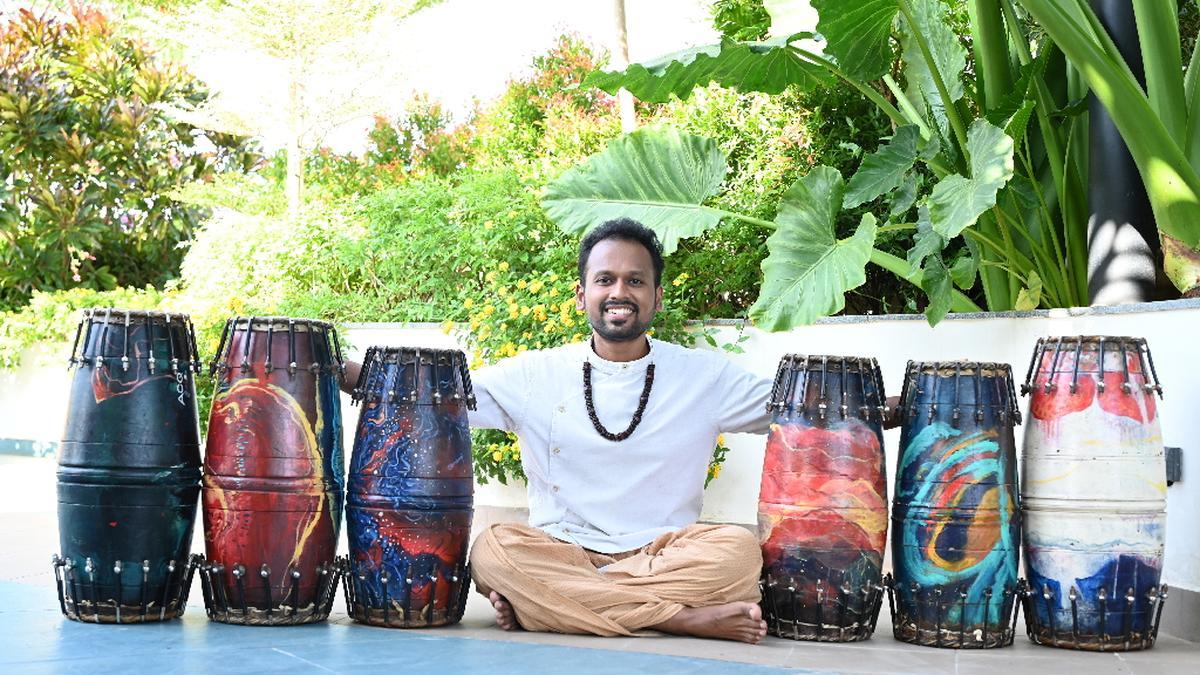
In the vibrant musical traditions of Southern India, percussion instruments serve as the rhythmic backbone, echoing the cultural tapestry of the region. Among these, the mridangam stands out, not just for its sound but now also for its appearance. Recent developments have seen this traditional drum transform into a dazzling canvas, with musicians infusing it with visual art that complements its musical prowess. This transformation has its roots in the evolution from traditional leather strap-bound mridangams to modern variations featuring nuts and bolts, resulting in exposed wooden surfaces ripe for artistic exploration.
Pioneering this artistic endeavor is virtuoso Patri Satish Kumar, who a decade ago inaugurated the ‘designer mridangam’ movement. His innovation stemmed from a profound desire to honor the instrument that has defined his musical journey. Inspired by the intricate carvings adorning Hindustani musical instruments, Satish Kumar adorned his mridangams with elaborate designs. Over time, other artists like Jayachandra Rao, Vinod Shyam Anoor, and Nandan Kashyap joined Kumar in this transformative journey, each contributing their unique artistic vision.
Satish Kumar’s designs draw inspiration from a rich palette of Indian art forms, including Warli paintings from Maharashtra, Madhubani art from Bihar, Kalighat paintings from West Bengal, patachitra from Odisha, and the evocative Kerala murals. Master artisans from diverse regions like Thanjavur, Palani, Pune, Kolkata, Bengaluru, Kerala, and Mangaluru have expertly realized his vision despite the inherent challenges of carving on a curved surface. This artistic synthesis not only celebrates but also preserves India’s rich cultural heritage.
Satish Kumar’s personal collection now boasts over 50 meticulously crafted mridangams. His first design was influenced by African drums, and subsequent creations featured motifs like conch shells, trishuls, and nandi, alongside geometric patterns. Carefully etched and polished with natural earthy hues of brown, black, and gold, each mridangam tells a story of spiritual and aesthetic significance.
Expanding the canvas of creativity, Satish Kumar adorned some drums with floral motifs echoing temple architecture. Meanwhile, Jayachandra Rao, another proponent of the movement, embarked on a journey with 10 mridangams, each painted in vivid colors symbolizing nature, divinity, and societal themes.
. His collaboration with a hearing-impaired artist from Andhra Pradesh brought forth extraordinary results. “We communicated through written notes, and I was amazed by his mastery,” recounts Rao, underscoring the profound connection forged between visual art and sound.
Rao’s first commission was with Seemanthini, an artist from Bengaluru known for Ganjam mural paintings, who transformed a mridangam by painting Nandikeshwar alongside the divinity’s 108 names. The impact was profound, as Rao describes a moment of divine inspiration during a performance, a testament to the spiritual connection forged through this artistic expression.
Praveen Sparsh contributes to this evolving narrative with his uniquely painted mridangams, each named in tribute to someone significant in his life, such as family and friends. His collaboration with visual artist Susha began with a music video project in 2018 and has since evolved into a remarkable collection marked by abstract patterns. Notably, a recent work features ocean-inspired hues and geometric designs dedicated to his ensemble ‘A Carnatic Quartet.’
Audience reactions have been overwhelmingly positive, with attendees often inquiring about the deeper meanings behind these designs. Performers like Praveen and Jayachandra attest to how these painted instruments have added a new dimension to the concert experience, enriching both the performer’s and audience’s engagement with the music.
In addition to their visual enhancement, these artistic transformations continue to receive accolades from seasoned musicians and maestros. Notably, renowned percussionists like Umayalpuram Sivaraman and T.V. Gopalakrishnan have praised these ventures, highlighting how the fusion of visual and performing arts elevates the overall creative experience. Patri Satish Kumar believes this evolution exemplifies the interconnectedness of the arts, ensuring that this newfound aesthetic dimension complements rather than detracts from the instrument’s musical integrity.
As the tradition of the mridangam continues to evolve, it stands as a remarkable testament to the endless possibilities that emerge when tradition intersects with innovation, echoing centuries-old rhythms while adorned with the colors and patterns of modern artistic expression.