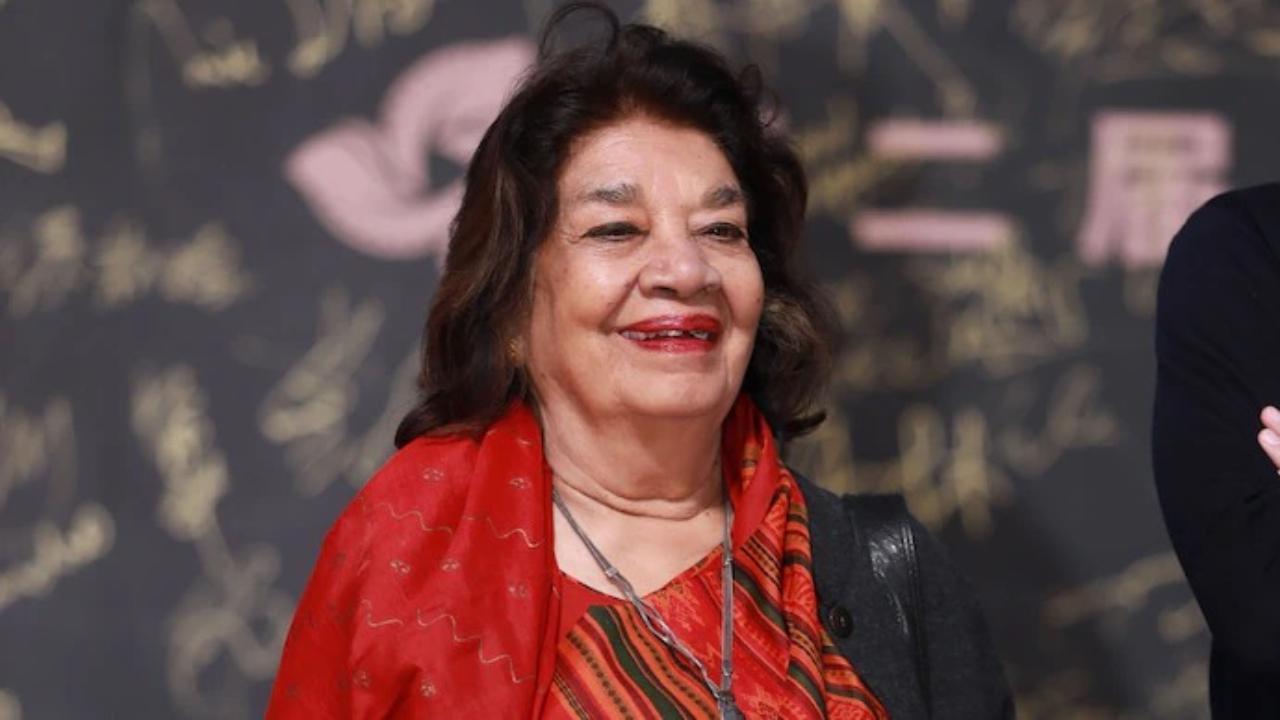
The world of cinema mourns the loss of Aruna Vasudev, an eminent film critic, curator, and author who passed away on Thursday morning at the age of 88. Vasudev, widely known as the ‘mother of Asian cinema,’ succumbed to age-related illnesses at a hospital in Delhi. Her close friend, Neerja Sarin, confirmed the news, revealing that Vasudev had been undergoing treatment at a multi-speciality hospital for the past three weeks. “She was not keeping well for some time. She had Alzheimer’s and was suffering from other old age-related health issues as well. She died at the hospital this morning,” Sarin told PTI.
Born in pre-independent India, Aruna Vasudev’s journey from modest beginnings to becoming a prominent figure in the cinematic world is nothing short of inspiring. She was a versatile individual who excelled in multiple fields – be it as a critic, author, editor, painter, documentary maker, trustee, or a member of several panels. However, she is most celebrated for her tireless work as an advocate for Asian cinema.
The Delhi-based scholar made significant contributions to the film community, most notably as the founder-editor of “Cinemaya: The Asian Film Quarterly.” This groundbreaking publication became the bedrock for promoting Asian cinema on a global scale. Over three decades ago, Vasudev also established Netpac (Network for the Promotion of Asian Cinema), a worldwide organization dedicated to furthering the cause of Asian films.
Her demise has left a void in the cinematic community, and social media has been inundated with tributes and messages of condolence. Veteran actor Shabana Azmi expressed her sorrow, stating, “She was the pioneer for making Asian films a genre to be talked about as a separate identity of its own. There are many laurels to her credit but I will always remember her for her warmth and radiant smile. Her observations were always insightful and I enjoyed being with her a lot. My condolences to her family. RIP dear dearest Aruna,” Azmi wrote on Instagram.
Film critic Namrata Joshi also paid homage to Vasudev, remembering her as a key figure in bringing world cinema to Delhi’s audiences in the 80s and 90s. “Growing up in 80s-90s Delhi, world cinema specially from Asia & the Arab world first came home to us because of the ceaseless untiring efforts of Aruna and Latika Padgaonkar through their Cinefan film festival and Cinemaya magazine,” Joshi shared on X.
Filmmaker Sania Hashmi also took to social media to express her gratitude, “Rest in Peace, Aruna Ma’am.
… Thank you for curating one of the best film festivals of Delhi. A lot of us were introduced to some of the finest world cinema because of you. #arunavasudev.”
Aruna Vasudev was also the driving force behind Cinefan, the Cinemaya Festival of Asian Cinema. Launched in 1999, it was one of the first film festivals globally to focus solely on Asian cinema. Her expertise and influence were further recognized through her role as a jury member at several prestigious international film festivals, including Cannes and Locarno.
As a testament to her lasting impact, the Tripoli Film Festival in Lebanon has instituted the ‘Aruna Vasudev Award’ for the best creation of cinema, celebrating her legacy. Throughout her illustrious career, Vasudev directed or produced around 20 documentaries and edited or co-edited several books. Among these works was a translation from French into English of Jean-Claude Carriere’s “In Search of the Mahabharata: Notes of Travels in India with Peter Brook.”
In 2021, Supriya Suri released the documentary “Aruna Vasudev: Mother of Asian Cinema,” which chronicles her journey as a film critic, programmer, and cinema activist. Vasudev also served as a board member of Alliance Française de Delhi, a leading Indo-French cultural center for French language and cultural immersion. Her studies at the Paris-based Institut des Hautes Etudes Cinématographiques and a PhD in cinema from the University of Paris, Sorbonne, underscored her deep connection with France. The French government recognized her contributions to cinema and the arts by bestowing upon her the Officier de l’Ordre des Arts et des Lettres in 2019 and Chevalier dans l’Ordre des Arts et des Lettres in 2002.
Neville Tuli, founder of the Tuli Research Centre for India Studies (TRIS), described Vasudev as the “epitome of a confident individuality rooted in a deep knowledge and appreciation for creativity, cinema, scholarship, and genuine compassion.” Tuli added, “Her thoughts were rooted in that rare desire to nurture the young & independent-minded film enthusiasts who wanted to make cinema their life. Naturally, she did not suffer fools or mediocrity gladly.”
The cinematic world has indeed lost a luminary whose contributions transcended borders and cultures. Aruna Vasudev leaves behind a legacy that will continue to inspire future generations of filmmakers and cinema lovers alike.