In the world of historical dramas, accuracy and meticulous research are pivotal. Director Laxman Utekar took this principle to heart while crafting Chhaava, a biographical film on the life of Chhatrapati Sambhaji Maharaj. Determined to deliver an authentic representation of the 17th-century Maratha king, Utekar and his team invested a year in rigorous research before the cameras started rolling in October 2023.
Laxman Utekar, aiming to portray the historic figure with utmost fidelity, collaborated closely with historians and the renowned costume designer Sheetal Sharma. Their collective effort was not limited to textbooks and scholarly articles but extended into extensive field studies. “Some filmmakers love playing with whites and pastels that are far removed from the world they are depicting, but Laxman wanted to be authentic in his storytelling,” a source revealed.
To get an accurate feel of the period, Utekar and Sharma embarked on multiple research trips to several towns significant to the Maratha history, including Aurangabad, Ratnagiri, Pune, Nashik, and Paithan. “Indians are not about pastels, but about a blast of colours. Laxman and Sheetal visited several forts and museums in these cities and towns that further gave them an insight into the dressing and culture of that era,” the source added. Their visits to these sites also allowed them to interact with historians specialized in the Maratha period, enriching their understanding even further.
A striking aspect of this elaborate research was the attention to detail in costuming. Chhaava, directed by Utekar, is an adaptation of the eponymous Marathi novel by Shivaji Sawant, and stars Vicky Kaushal as Sambhaji Maharaj, Rashmika Mandanna as his wife Yesubai, Divya Dutta as his stepmother Soyarabai, and Akshaye Khanna as the Mughal emperor Aurangzeb. For Rashmika Mandanna’s role, the costume design team sourced authentic Paithani and Narayanpeth sarees from regions like Paithan and Narayanpeth. Given the scarcity of original fabrics from that era, the team visited museums, photographed rare textiles, and tasked weavers with replicating these historical designs. They even went to the extent of purchasing and restoring antique sarees, some featuring 500-year-old borders.
. “Rashmika has worn many Paithani sarees with Chandrakala designs,” said the source.
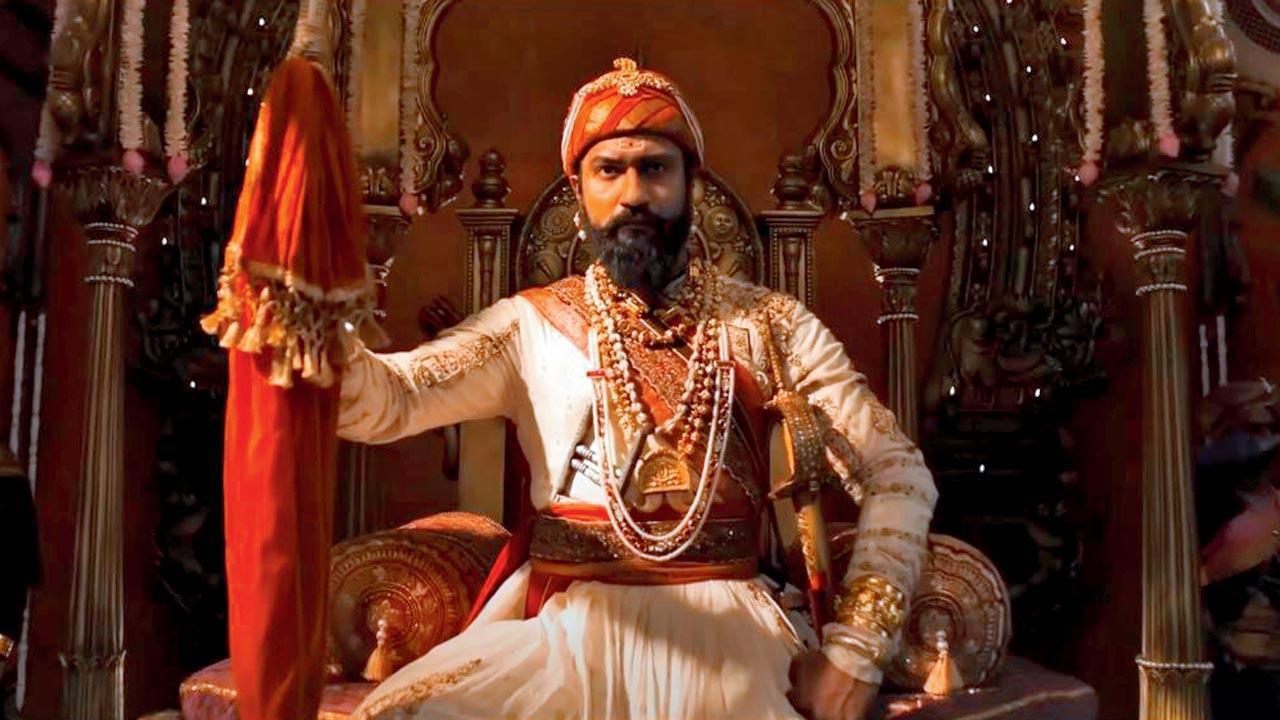
Vicky Kaushal’s portrayal of Sambhaji Maharaj was heavily influenced by existing statues and busts of the historical figure. Historians compiled numerous images of Sambhaji’s busts from Sambhajinagar, Pune, and Nashik, forming a foundation for Kaushal’s look. One of the more iconic scenes in the film, featuring Kaushal seated on a throne, was directly inspired by a bust located in Pune. The production team didn’t stop at costumes; they also meticulously sourced appropriate accessories. Jewellery and other items were collected from locations like Kolhapur, Sawantwadi, and Ratnagiri to ensure they exuded an old-world charm. Specifically, Rashmika was adorned with a Lakshmi haar and a nath—a traditional nose ring—based on artefacts studied in various museums.
The production design process carried similar rigor. Sambhaji’s legendary sword, Bhavani, was recreated with the same precision. The production designers, Subrata Chakraborty and Amit Ray, took inspiration from a version of Bhavani housed in a London museum. This level of detail speaks volumes about the commitment of the production team to create an immersive and authentic cinematic experience.
As shooting began in October 2023, these efforts to guarantee historical accuracy were expected to pay off, giving audiences a vivid and precise depiction of Chhatrapati Sambhaji Maharaj’s life and times. Authenticity in representation was a paramount aim for Utekar and his team, ensuring that everything – from the colours and textures of the costumes to the design of the accessories and weaponry – was historically accurate.
In summary, Chhaava isn’t merely a film; it stands as a testament to the dedication and hard work of its team, who left no stone unturned to revive the 17th-century Maratha era on screen with utmost authenticity. Their year-long process of research, field trips, consultations with experts, and detailed recreations highlights their collective commitment to preserving and presenting history through the lens of cinema.