The second season finale of The Rings of Power has made its mark as an audacious evolution from its tentative beginnings, crafting a vibrant, immersive retelling of Middle-earth rather than just a big-budget spectacle. While some may argue that the episode didn’t resolve every lingering question or satisfy the expectations of Tolkien purists, it accomplished a crucial feat — it redefined the narrative from a high-risk production into a captivating saga. In its second season, what began as a glossy and somewhat uneven revival attempt has matured into a narrative that is richer, more daring, and surprisingly self-assured.
Season one left an impression with its grandiose landscapes, meticulous CGI, and the tremendous burden of Tolkien’s legacy hanging over its narrative like a sword. Despite all these elements that marked it as a significant television event, the series initially felt constrained by its own monumental expectations, like a beautiful spectacle trapped within a gilded cage. However, the sophomore season has taken the mild criticisms from its debut to heart and executed a course correction, culminating in an epic finale. This season, steered by a well-intentioned Dark Lord, has unshackled itself, finally feeling free of its initial restraints.
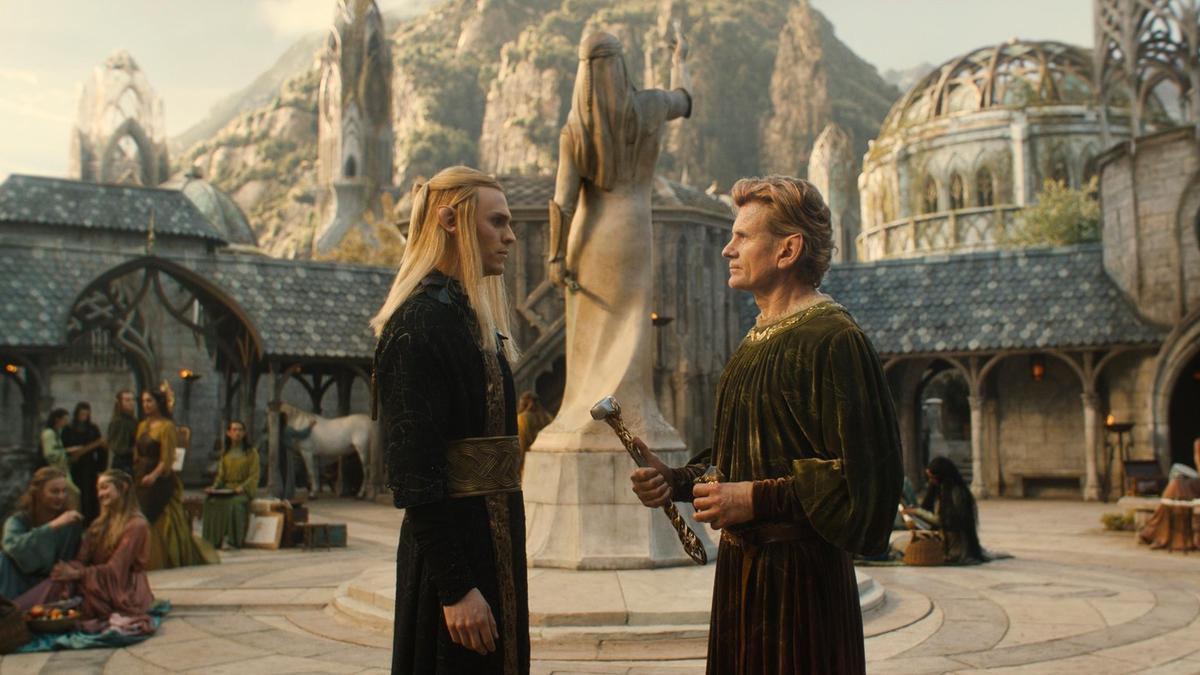
Characters and plotlines that initially seemed incidental have now intertwined seamlessly, amplifying the core themes of power, corruption, and the seduction of evil. This coherence has resulted in a narrative that, while still with room to grow, feels much more holistic. Central to this season’s narrative is the looming presence of Sauron, whose character is portrayed with chilling nuance by Charlie Vickers. The embodiment of “the great deceiver” is executed as a slowly unraveling villain — a charming manipulator whose outward genuineness hides an insidious intent.
Opposite Vickers, Charles Edwards shines as Celebrimbor, a figure consumed by his own faith and ambition, oblivious to the manipulative snare closing in around him. Their interactions are akin to a tragic dance of trust and betrayal, executed with brilliant subtlety, culminating in an intricate revelation of Sauron’s true nature. This gradual unveiling is not a sudden shock but a meticulously crafted infiltration, intensifying throughout the season’s progression. Together, their performances elevate The Rings of Power into a psychological tragedy set against a backdrop of epic stakes.
As the second season reaches its climax in a visually spectacular, battle-laden finale, the series excels in delivering the anticipated grandeur. The visual effects in the vast and intense scenes — from the luminescent battlefields of Eregion to the cataclysmic struggle within the depths of Khazad-dûm against Durin’s Bane — are nothing short of outstanding. Despite being surrounded by fiery swords and collapsing citadels, the storyline maintains its emotional foundation, highlighted by the touching yet brief relationship between Prince Durin IV and his father, King Durin III.
. Their dynamic, shaped by ancestral duty and pride, adds a poignant human element, counterbalancing even the formidable spectacle of a Balrog and glittering mithril veins.
Where fledgling endeavors might tether themselves to gritty realism, The Rings of Power revels in its fantastical roots, inviting viewers to lose themselves in the awe of Middle-earth. It calls us to witness the sheer wonder of it, from the ethereal glow of Valinor to the betrayals embedded in molten mithril’s brilliance. This production embraces the art of fantasy in its purest form, refusing to dull the magic for mere prestige. Even when the storyline momentarily wavers, its grandeur remains unshaken.
The show’s appeal might not extend universally, particularly to those who prefer the darker hues akin to Westeros, but it offers a nostalgic revisit to fantasy’s inherent allure. It reminds us of the magic of believing in worlds where good and evil are locked in eternal strife, and invites us back into the domain of wonders, dangers, and visceral beauty.
Nevertheless, as triumphant as this season has been, lingering shortcomings remain. The Harfoots, for instance, continue to feel somewhat detached from the central plot, included seemingly for whimsical relief rather than narrative progression. Their presence, while endearing, might be scaled back in future seasons. Similarly, while the dramatic wrap-up of Sam Hazeldine’s Adar was a poetic conclusion, it leaves a void for his admirers as we bid farewell to his compelling portrayal. Yet, we did get a clumsy “Grand-Elf” reveal, which felt rather underwhelming given the build-up.
With the second season drawing to a close, it’s evident that The Rings of Power has learned significantly from its initial missteps. The series strides forward with greater narrative confidence and determination, embracing the expansive mythos of Middle-earth. Although it might never completely escape the shadow of Peter Jackson’s illustrious film adaptations, the show is carving out its own distinctive identity. Middle-earth, once again, is a realm of enchantment, danger, and captivating allure, for which viewers can only express gratitude. All episodes of The Rings of Power are available to stream on Amazon Prime Video.