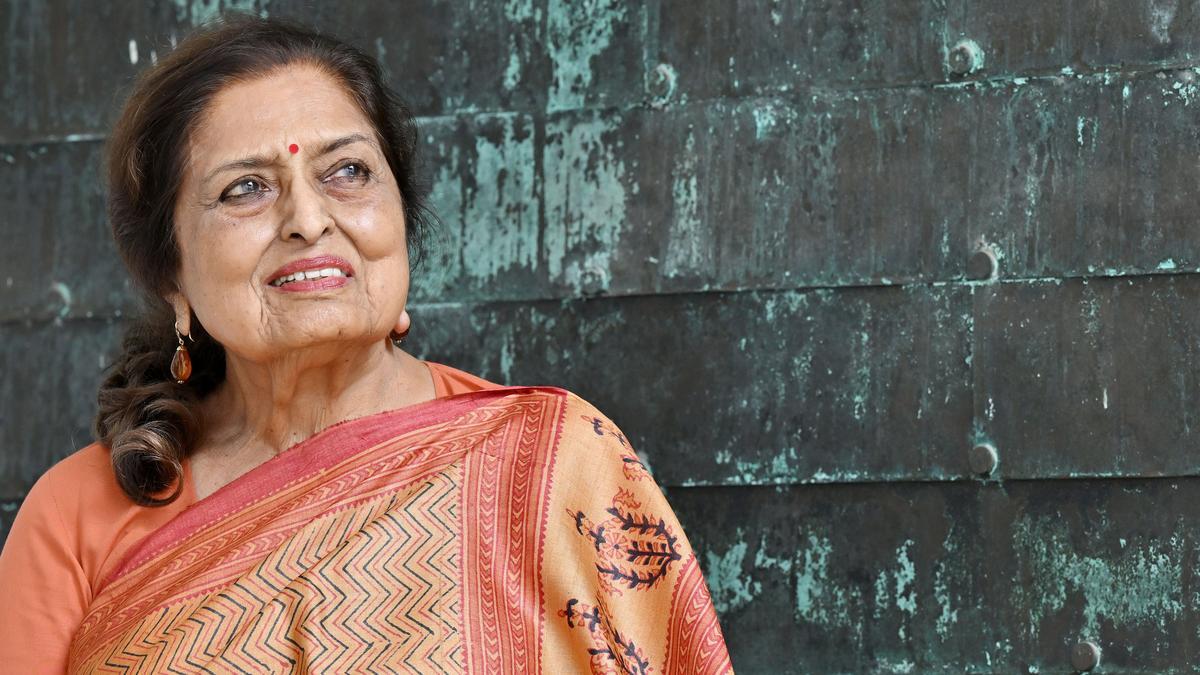
Saryu V. Doshi, a towering figure in the world of art since the 1960s, stands as a symbol of India’s artistic journey. Emerging during a time when India, as a freshly independent nation, was striving to articulate its rich cultural legacy on a global scale, Doshi played a pivotal role in bridging cultural connections through her deep-rooted interest in art history. Her path was not one she had foreseen, but it led her to a lifelong passion. In 1956, her journey to the University of Michigan alongside her husband turned into an exploration of art history, which would go on to define her career. Upon returning to Mumbai, she quickly immersed herself in its vibrant intellectual circles, and from that point forward, she did not pause.
Now an esteemed octogenarian and recipient of the Padma Shri, Doshi is celebrated primarily as a leading scholar on Jain art and architecture. Yet, to delineate the boundaries of her influence is a challenging task. Her contributions have been manifold: as an editor of the acclaimed Marg magazine, the founding director of the National Gallery of Modern Art in Mumbai, and the pro tem chairman of the Lalit Kala Akademi. In the 1970s, her academic pursuits also led her to teaching roles at the University of Michigan and the University of California, Berkeley. Moreover, she holds the title of honorary fellow at the Bombay Asiatic Society and is the editor of the research journal of Chhatrapati Shivaji Maharaj Vastu Sangrahalaya (CSMVS). Doshi is highly regarded by her peers, who speak of her dedication, passion, and her meticulous nature. This revered art historian was recently in Chennai to lead a lecture series on the intricate relationship between Jain art and spirituality, an event organized by Prakriti Foundation and the Chennai Chapter of INTACH.
During a reflective interview, Doshi shared insights into her vast career and her involvement in various capacities beyond traditional art. She has been part of a committee for film script writing, a member of the tourism board, and even served on a committee responsible for allotting telephone connections. Reflecting on these roles, she noted her initial surprise but soon understood the necessity for an art representative in these spaces. Doshi’s enthusiasm for interdisciplinary engagement is evident in her attendance at a wide array of cultural events, including theatre, music, and dance, along with her appreciation for connecting with people from diverse fields. Her household once served as a cultural hub, supporting Marathi theatre and fostering a rich environment for classical music and arts, making it a gathering space for artists and intellectuals. This cultural milieu undoubtedly shaped her, leading her even to design costumes for a Marathi adaptation of the play “Tughlaq.
.”
Doshi’s unwavering curiosity about the narrative behind art, beyond what is immediately perceivable, fuels her scholarly pursuits. This inherent inquisitiveness distinguishes the analytical mindset of an art historian from the intuitive nature of an artist. Her ventures into Jain art were sparked by an intriguing suggestion from Moti Chandra, an art historian who encouraged her to explore the stored art treasures in Jain temple bhandars. This advice set her on a path to discovering unique artworks, such as an exquisite painted scroll in a Digambara Jain temple near Nagpur fifty years ago. Her research revealed a fascinating blend of Rajasthani, Mughal, and Deccani elements, linking these artistic influences to Aurangabad—a novel association at the time.
The amalgamation of styles emerged as a consequence of Mughal armies, accompanied by Rajasthani generals and artists, settling in the Deccan, resulting in a unique cultural and artistic fusion. Saryu V. Doshi’s scholarly work continues to draw students and art enthusiasts alike to libraries, such as CSMVS, where she frequently visits to write and edit. She relishes the opportunity to impart her knowledge, especially as interest in art history burgeons among younger generations.
Contrary to concerns about diminishing interest, Doshi notes a resurgence in museum attendance, largely driven by younger demographics. This generational shift, she believes, is a sign of increasing enthusiasm for art history, reflecting broader engagement with India’s artistic heritage. However, she highlights a gap in the systematic preparation of staff for new museums, both government and private, which are flourishing across the nation. Doshi advocates for an analytical approach to art documentation, urging students to probe beyond mere observation and to understand the evidence of cultural artifacts.
The evolving art landscape, marked by art fairs, biennales, and innovative museums, showcases a dynamic shift from historical narratives to more civilizational themes. These changes, she argues, challenge traditional curation and provoke debates about the placement of cultural artifacts—whether they belong in situ or within a museum’s infrastructure. Architecture, too, plays a crucial role, with museum designs embracing imaginative displays that transcend conventional stylistic histories, reflecting the evolving narrative of India’s art and culture. Saryu V. Doshi’s career embodies this journey, encompassing both landmark achievements and the ongoing transformation of cultural institutions, ultimately enriching India’s artistic panorama.