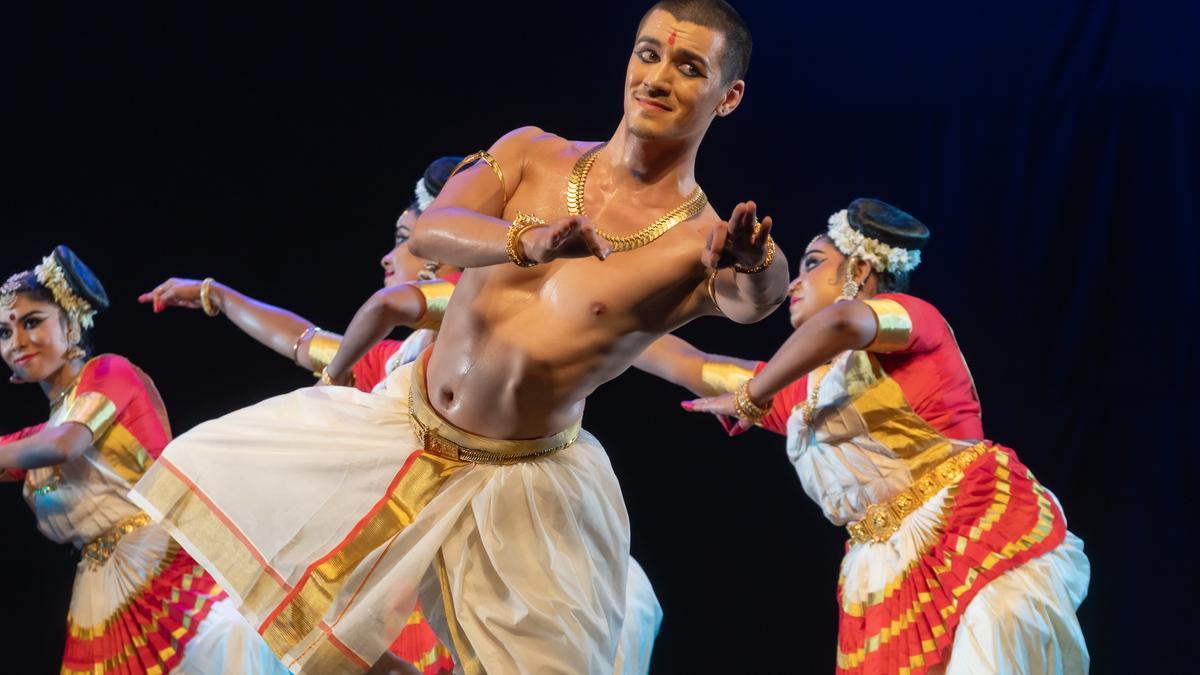
Thomas Vo Van Tao, known for his expressive abhinaya, is a rare male Mohiniyattam exponent from France. After learning Bharatanatyam for 10 years, he veered towards Mohiniyattam, where he found his true calling. His aesthetics were further shaped under the tutelage of Neena Prasad. Today, Thomas performs extensively and teaches Mohiniyattam in Paris. Here are excerpts from a conversation with him.
**Question: What drew you to Indian classical dance?**
**Answer:** I was around eight when I happened to watch a documentary on South India on TV. At the end of the documentary, there was a short excerpt of a couple dancing together, and it left me fascinated. A few years later, by chance, I met my first teacher, who taught me Bharatanatyam for more than 10 years. Mohiniyattam came much later in my life when I traveled to Kerala and decided to give it a try. The first class was a sort of revelation.
**Q: Mohiniyattam is often labelled as the dance of the enchantress and was traditionally performed by women. Why did you choose this dance style, and do you ever feel constrained by your gender?**
**A:** I stopped Bharatanatyam and gravitated towards Mohiniyattam due to the sense of plenitude I experience every time I perform it. The slow or medium pace of Mohiniyattam and the nature of its movements made me feel that I was finally dancing. As a Bharatanatyam student and dancer, I was expected to dance in a certain way and was only taught certain compositions that were supposed to highlight my masculinity. Without realizing it, I was in search of a dance that resonated more with who I am and that allowed space for what we label as femininity. I wouldn’t say that my gender was ever a constraint. On the contrary, Mohiniyattam gave me ample space to explore and fully embrace my gender in its complexity. Now, is my gender perceived by a few as a constraint? Yes, certainly.
**Q: What about language? Is that ever an obstacle? Can you emote without comprehending the lyrics?**
**A:** When it comes to dance compositions, I don’t think the language is more of an obstacle for me than it is for any other Indian dancer from India. Your question is interesting, as I don’t think anybody would ask a Bengali or a Gujarati Bharatanatyam dancer whether the languages of their compositions, mostly in Telugu and Tamil, are obstacles for them to emote. We all fall back on translations or have friends help us translate and understand certain lyrics. Moreover, a native Tamil speaker might not be able to fully understand a Sangam-era text, nor a Malayali a heavily Sanskritised Manipravalam text.
One of the misconceptions about Mohiniyattam is that its entire repertoire is in Malayalam/Manipravalam. This is partly due to the perception that Mohiniyattam is a regional dance form. While this is true to an extent, Mohiniyattam’s repertoire has always included compositions in various languages.
. For example, the first Varnam taught in Kalamandalam was in Telugu, not Malayalam.
To answer your question more practically, yes, it does make a difference to know the language of the composition as it brings more spontaneity in abhinaya. The only area where I definitely feel I am missing out is when it comes to everyday communication in Kerala.
**Q: You also have training in research. Did research come to inform your practice in some ways? Do you primarily dance what you have been taught by your gurus, or are there new interventions too based on what you have read and know about the history of Mohiniyattam?**
**A:** Yes, I wrote my Master’s thesis on the contemporary history of Bharatanatyam. This research impacted my practice and, to some extent, was crucial in my decision to stop practicing this art form. I was conflicted between what I was reading about the history of Bharatanatyam and what was taught to me in dance class. The bhakti-loaded repertoire that was taught to me, with its supposed antiquity and sacredness, did not match with what I was reading about the traditional repertoire of Bharatanatyam.
I have not done formal research on Mohiniyattam, but I do read everything I can about it. Unfortunately, only a few academic works have been dedicated to this art form, especially its history, as all the pre-Kalamandalam era practitioners and witnesses of their art are no longer alive.
**Q: You live and work in France. You have performed in Europe. Is that a challenge for a performing artiste? How do you reconcile this difference?**
**A:** There is a long tradition of non-Indian practitioners of Indian dance in France. Simkie, the first French lady who learned Indian dances, did so as early as the 1930s during the Revival Period when a whole new narrative was being created around Indian dance traditions. Indian dances are not completely alien to many here, but that paradoxically makes it even more difficult for me to set a context for my practice. Reconciling my experience in India as a student and dancer with people’s perceptions of Indian dances can be challenging. The audience often comes to see or experience what they consider exotic or ancient, with preconceived notions based on what they have read about the so-called revival. Ensuring that the art form my students learn or the audience sees evolves and thrives isn’t something one can achieve in a short class or a five-minute conversation after a performance. It requires ongoing work, comprising spreading awareness through performances but also making people understand that things aren’t so vastly different and exotic.
**Q: Is Mohiniyattam contemporary? Do you feel the need to make it contemporary to your time and context?**
**A:** Mohiniyattam, or Indian dance for that matter, is not bound by time and space. It’s an art made and practiced by people of today, and no matter how ancient it is or isn’t, it keeps moving forward, constantly creating and recreating itself through different bodies. So yes, Mohiniyattam is contemporary, and I would even say it’s probably ahead of its time. It asks us to slow down and observe.
(Kunal Ray writes on art and culture. He teaches at FLAME University, Pune.)
Published – September 23, 2024
Friday Review