
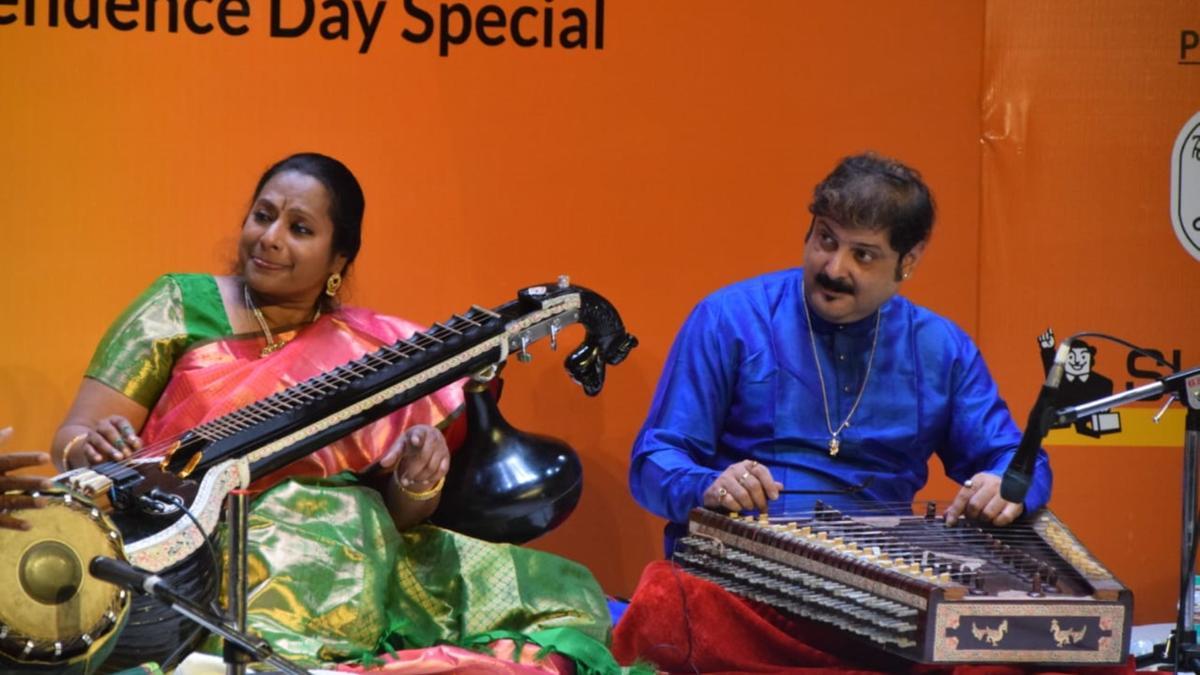
The harmonious fusion of India’s classical ethos and folk traditions took to the stage recently as two master musicians—U.S.-based vainika Nirmala Rajasekar and Kolkata-based santoor exponent Sandip Chatterjee—joined forces for a rare jugalbandi. The event melded the ancient classical music heritage epitomized by the Saraswati veena with the rustic charm of Kashmir’s folk santoor. This innovative collaboration made its debut in India, capturing the hearts of many, before the duo embarked on their ongoing tour in America.
Their unique musical ensemble, consisting of a staggering 100 strings, married the santoor’s 93 strings—seven of which Sandip removed for this performance—with the veena’s set of seven strings. This intricate symphony paved the way for an extraordinary auditory experience.
Nirmala Rajasekar, a ninth-generation aficionado of the veena, expressed her enthusiasm for this groundbreaking musical endeavor. Although the concept of merging these two instruments had been previously explored by notable musicians Kannan Balakrishnan and Bhajan Sopori in a concert organized by Sangeet Natak Akademi, Nirmala and Sandip’s performance breathed new life into the practice.
The recent performance took place in Delhi, where the duo was accompanied by tabla maestro Ramdas Palsule and mridangam virtuoso Thanjavur K Muruga Bhupathi. The concert’s careful structure highlighted the distinctiveness of each instrument while skillfully showcasing their potential for confluence. Given the common ragas shared by Hindustani and Carnatic musical systems, the jugalbandi flowed seamlessly.
Nirmala commenced the concert with an ode to Ganesh titled ‘Gam Ganapathe,’ blending her instrumental prowess with vocal finesse. The mridangam’s rhythmic support amplified the melody. In contrast, Sandip graced the audience with a different ‘gat’ in Raga Hamsadhwani, perfectly complemented by the tabla’s crisp bols from Ramdas Palsule. This contrast in their performances allowed for a rich tapestry of sound.
Acoustically, the deep, resonant bass of the veena contrasted sharply with the santoor’s light, fluttery notes. The veena allowed for greater fluidity and movement within the notes, whereas the santoor’s dexterity posed challenges for the more grounded veena. Despite these differences, both artists utilized their respective instruments’ characteristics to complement each other’s performances.
.
An interesting anecdote from the concert involved pitch adjustment. Sandip noted, “My santoor is usually tuned to ‘D’, but I had to change my pitch to play in ‘E’.” Nirmala’s veena, crafted with travel ease in mind, couldn’t be tuned lower than ‘E’. Therefore, Sandip adapted by changing his scale and making ‘Re’ (D) his ‘Sa’ (C). He shared, “Instead of re-tuning the santoor to a pitch where it may not resonate well, I adjusted my playing. This is difficult to sustain over a long concert, but I like challenging myself.”
Sandip’s santoor technique is also quite unorthodox. Unlike the traditional method, which employs two mallets, Sandip plays using only one, while the other hand plucks the sympathetic ‘tarab’ strings. This approach, inspired by Ustad Vilayat Khan’s handling of the ‘tarab’ strings, produces a unique sound. “I try to emulate Vilayat Khan sahib’s handling of the ‘tarab’ strings. I use just one mallet, and with the other hand pluck the ‘tarab’ wires. My instrument has only two ‘tarabs’; I removed the other two since they resonated too much. In music, it’s not hard to find a meeting point,” Sandip shared.
The concert was a testament to the boundless possibilities of Indian classical music when openness to innovation and tradition converge. It also underscored the musicians’ artistic resilience and their ability to adapt while retaining their core musical identities.
Both Nirmala and Sandip have set a new benchmark with their collaboration, proving that music, regardless of its origins, can find a harmonious middle ground. The world of Indian classical music and regional folk traditions awaits with bated breath for their forthcoming performances in America. As they prepare for this international journey, they carry with them the promise of furthering this magnificent, 100-stringed dialogue.